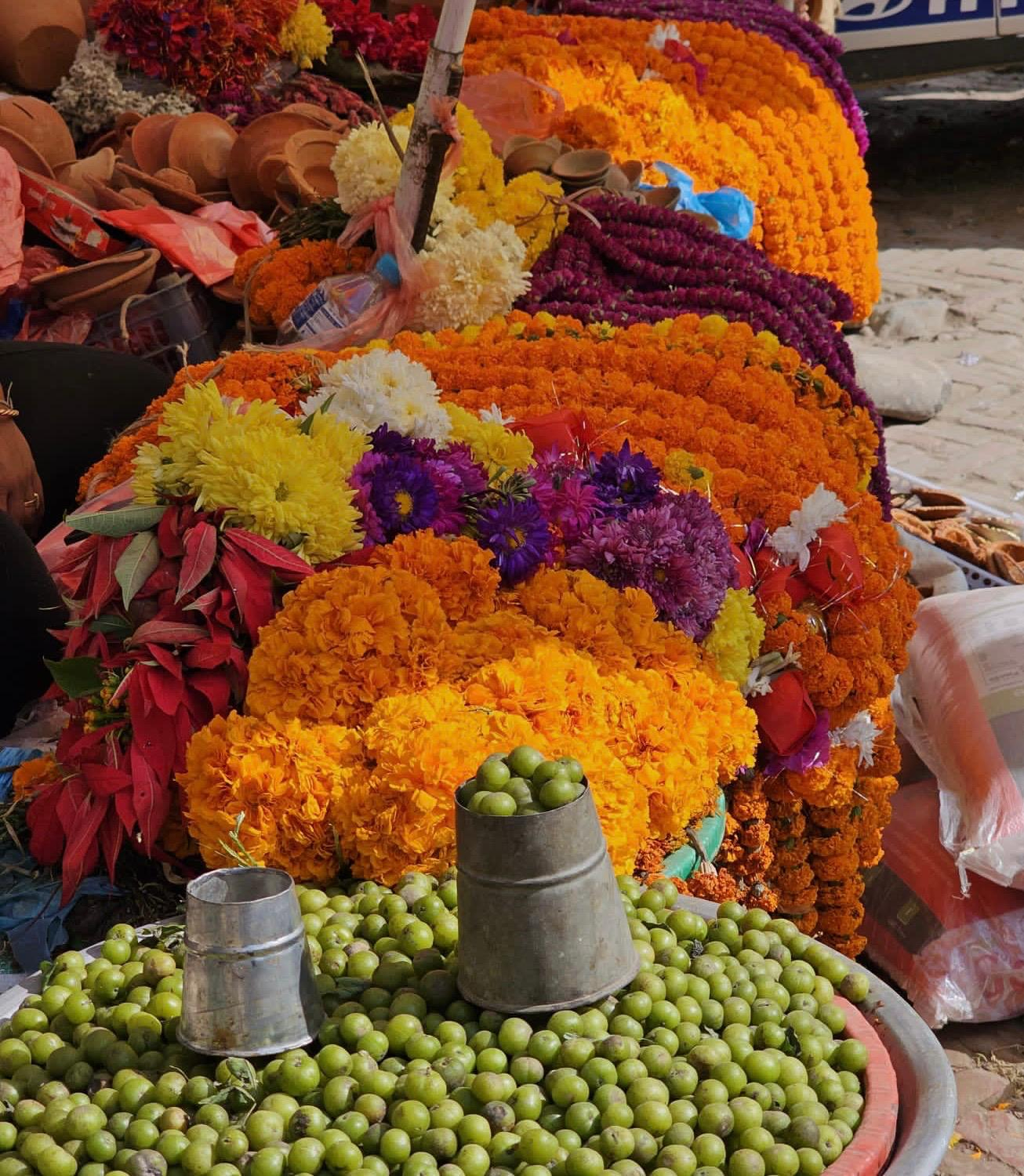
After exploring the Thamel district, we spent two days exploring Kathmandu’s ancient sites.
Day 1 of exploring Kathmandu’s ancient sites:
After having breakfast at our hotel, we were warmly greeted by our travel company host Raj, who drove us through the city and helped us navigate all entrances and fees. We don’t recommend driving in Kathmandu so hiring this travel company was key to our ability to navigate through the busy traffic and make the exploration of Kathmandu easy and seamless.
No visit to Kathmandu would be complete without exploring its rich spiritual heritage. We began our day with a visit to Swayambhunath, also known as the Monkey Temple, perched high atop a hill overlooking the city. Its gleaming white stupa and fluttering prayer flags offer a serene retreat from the chaos below.


As we climbed the steps, we were greeted by countless macaque monkeys, grooming one another and lazing around. We watched the larger male monkeys running around stealing offerings of rice, and flowers, deposited at the foot of the temples.
Our guide taught us about the religious significance of this site, as Hindus and Buddhists worship side-by-side. He then led us to a rooftop of a local art shop. This hidden gem gave us a wonderful view of the city landscape below, with the backdrop of the Himalayas.


Our next stop was Kathmandu Durbar Square, a UNESCO World Heritage Site and the historic heart of Kathmandu. Here we visited ancient palaces, temples, and courtyards. Pigeons flooded the squares in the pedestrian area of the old city.
Although Nepal is now a republic, it was only in 2008 that the monarchy was abolished. We marveled at the intricate wood carvings of the Hanuman Dhoka Palace and had the opportunity to catch a glimpse of the sacred Kumari, thought to be the living incarnation of a Hindu Goddess. This young girl occasionally gazes down on visitors in a small courtyard, thought to be a blessing to all who see her. Note: no photography of her is allowed.


As we wandered through the maze-like streets of the surrounding neighborhood, we were immersed in the local culture. People gathered at public watering holes and open-air platforms. Women carried goods on their heads, despite cars and motorbikes flying by. A large earthquake in 2015 damaged many buildings, and the scaffolding still remains – often made from bamboo and tied together with rope.


From there, we continued on to Patan, known as the City of Fine Arts, where we marveled at the exquisite architecture of the Patan Durbar Square and explored the hidden courtyards. The detailed wood carvings and statues exceeded our expectations in such an ancient place. We were particularly drawn to the Ganesh elephant and Hanuman monkey god statues adorned with colorful gulal powder and marigold flowers.


That evening we went to dinner at “Places Restaurant & Bar” back in the Thamel district. We sat on the floor, seated at a low table, and enjoyed a healthy vegetarian dinner and kombucha. Highly recommend!
Day 2 of exploring Kathmandu’s ancient sites:
Our first stop was Boudhanath Stupa, one of the largest Buddhist shrines in the world. This stupa is visually stunning and also offers a bit of tranquility in the busy city. Devotees walk around the sacred dome, chanting prayers and spinning prayer wheels. We watched the faithful methodically paint the walls and stupa dome in white paint. The rows of colorful flower offerings were a stunning contrast to the white stupa. Here we were blessed by a monk and made a small donation to the monastery. The walkway surrounding the stupa is also relaxing place to sit, have a coffee, and people watch.


Next, we made our way to Pashupatinath, a sacred Hindu temple complex and pilgrimage destination for Hindus from around the world. As non-Hindus, we were not allowed to enter the temple but could observe the beauty from outside the gates. We were greeted by several Holy men that offered us a blessing.

Also here, on the banks of the Bagmati River, we witnessed open-air cremations, as mourners cremated their loved ones on platforms and spread their ashes into the river’s holy waters. A word of caution: this was a heavy experience, and human remains may be visible in their fires.
We then traveled outside the city to Bhaktapur, a medieval city frozen in time, where narrow alleys are lined with traditional Newari houses. Here artisans practiced their crafts, including clay pot making at an incredible rate. It was fun to watch their precision and speed, in an almost meditative repetition…
We also watched as the locals spread their freshly harvested rice out to dry and later came across offerings of freshly sacrificed animals at the neighborhood temples, with the smell not for the faint of stomach. This raw way of life was truly an intense cultural experience.


Kathmandu captured our hearts in a way that we wouldn’t have imagined. As we headed off to the Nepalese jungles, we knew Kathmandu would call us back. Until next time, Kathmandu, Namaste.





Leave a Reply